
Picking the wrong agent can quietly cost you thousands. In Cambridge, the average property changes hands for around £472,000, so even a small gap in the price achieved or the commission charged adds up fast. Plenty of sellers and landlords still sign with the first firm that knocks on the door.
Working with an experienced team of Cambridgeshire Estate Agents gives you postcode-level pricing insight and a marketing plan built for your street, rather than a template lifted from head office.
Cambridgeshire holds several very different markets, from city flats to Fenland family homes. The right agent reads those differences. Here is how to compare them properly before you commit.
Key Takeaways
- Shortlist three local agents and weigh their results, not the highest valuation or lowest fee.
- Confirm redress scheme membership and a professional body before you sign anything.
- Sole agency commission averages near 1.42% with VAT; rival models often cost more.
- Read the contract for tie-in periods, withdrawal charges and marketing extras.
- Communication and portal-ready marketing matter as much as the headline rate.
Why the Right Agent Matters in Cambridgeshire
Cambridgeshire spans several distinct property markets, each with its own buyers, tenants and price points. Cambridge city commands the highest values, driven by the university and the science cluster around the Biomedical Campus and Science Park.
Villages across South Cambridgeshire draw families and London commuters. Northern market towns such as Ely, March and Wisbech offer lower entry prices and, for landlords, stronger rental yields.
The average Cambridge home sold for about £472,000 in early 2026, while the wider county figure sat closer to £364,000.
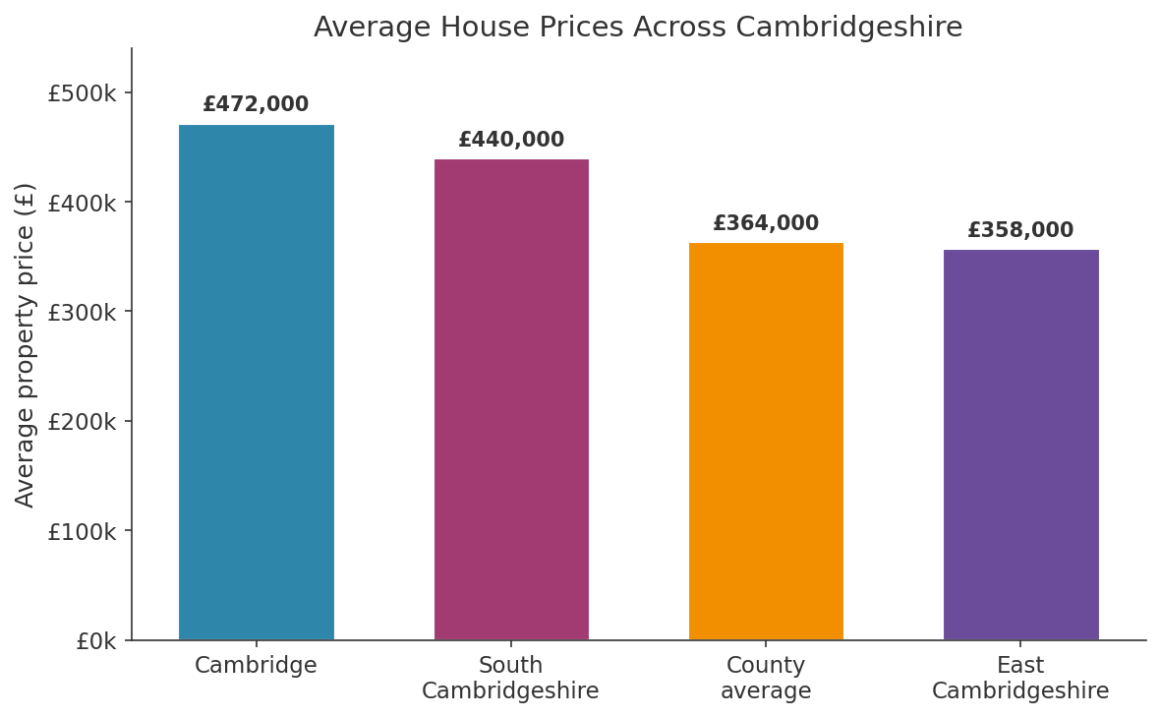
Average property prices vary widely across the county (Sources: ONS UK House Price Index; HM Land Registry).
An agent who works your town every week reads demand far better than a chain pricing from a spreadsheet. That local feel shapes the asking figure, the buyer pool and how fast you complete. You can sense-check any valuation against the official house price data for Cambridge before agreeing a number.
Prioritise Track Record Over a Flattering Valuation
A proven track record tells you more than any glossy brochure. Look for completed sales or lets rather than a long list of live boards, since heavy advertising can hint at a firm that wins instructions but struggles to close them.
Search the major portals for results marked Sold STC or Let Agreed near you, then note which names keep appearing. Those agents are converting interest into deals.
|
Watch out: Some agents quote an inflated figure to win your business, then push for a price drop a few weeks later when viewings stall. Treat the boldest valuation with caution. |
First impressions still sell homes, so tidy the outside before any photographs are taken. Quick wins on kerb appeal feature in the exterior design guides here, and they often pay for themselves at offer stage.
Check Credentials, Regulation and Redress
Estate agents in England work under clear legal duties. Any agent handling residential business must belong to a government-approved redress scheme, either The Property Ombudsman or the Property Redress Scheme.
A redress scheme is an independent body that buyers, sellers, landlords and tenants can turn to when a complaint cannot be settled directly with the agent.
Letting agents and property managers carry the same duty, plus Client Money Protection, an insurance arrangement that reimburses landlords and tenants if money held on their behalf is misused.
|
Key figure: These schemes can award up to £25,000 in compensation, and an agent who fails to join one risks a fine of up to £5,000. |
Membership of a professional body such as Propertymark, through its sales arm NAEA or lettings arm ARLA, signals extra training and a code of practice. It is voluntary, yet it is a useful sign of a serious operator.
Compare Fees and Contract Types
Estate agent fees in the UK usually take one of two shapes: a percentage of the sale price or a fixed amount agreed upfront. The structure you pick affects both cost and motivation.
Sole, Multi-Agency and Online Models
Sole agency means one firm holds the exclusive right to sell or let your property for an agreed term. It is the most popular route and usually the cheapest, averaging roughly 1.42% including VAT.
Multi-agency lets several firms compete, with only the winner getting paid, and usually runs to between 2.5% and 3%. Online and hybrid agents advertise far lower headline rates, sometimes as little as 0.5%, though many charge upfront whether or not the property sells.
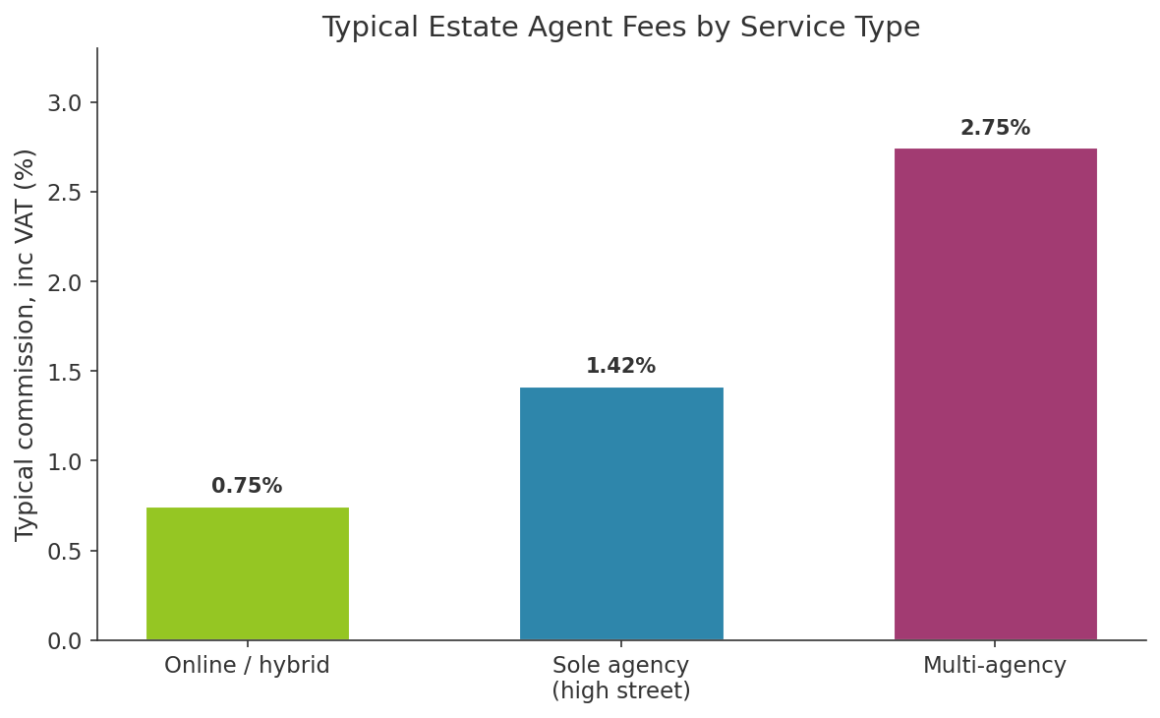
Headline commission rises with exposure and competition (Sources: AgentSeeker; HomeOwners Alliance).
|
Feature |
Sole agency |
Multi-agency |
Online / hybrid |
|
Typical fee (inc VAT) |
About 1.42% |
2.5% to 3% |
0.5% to 1% |
|
How it works |
One firm, exclusive |
Several firms compete |
Mostly remote service |
|
Contract tie-in |
Often 8 to 12 weeks |
Usually shorter |
Varies, often paid upfront |
|
Best suited to |
Most sellers and landlords |
Homes that are slow to shift |
Confident, hands-on owners |
Tie-In Periods and Hidden Costs
Read the contract before the valuation flattery wears off. Sole agency deals often lock you in for eight to twelve weeks, and leaving early can trigger charges.
Look closely for withdrawal fees, non-refundable photography or marketing costs and automatic renewal clauses. Each one can turn a tidy headline rate into a larger bill.
On a sole agency deal, aim for around 1.2% including VAT, but remember the best performer can be worth a higher rate.
Commission is rarely fixed. Many agents will trim a sole agency rate by 0.2 to 0.4 percentage points if you ask, especially when your property is easy to market or you are flexible on timing.
Assess Marketing, Viewings and Communication
Marketing decides how many of the right buyers ever see your home. Most searches begin on property portals, so listings need professional photography, a clear floorplan and an accurate description. Ask which portals the agent uses and whether video tours come as standard.
Presentation counts too. A clean, well-styled room photographs better and shows faster, and simple staging ideas in the interior design section can lift your images at no real cost.
Sorting small repairs before listing avoids awkward questions at viewings. A quick run through these home maintenance tips works well as a pre-launch checklist.
Communication is the area sellers grumble about most. Test it early by ringing the office as a would-be buyer and seeing how quickly staff respond and how they talk about other homes on their books.
[Video: “How to CHOOSE the right ESTATE AGENT” | https://www.youtube.com/watch?v=unQZhJats9Q]
Note: a short walkthrough of what to look for when comparing agents for a sale or a let.
Real feedback shows that momentum in action. In a Google review, customer Kennedy Chari described the journey from first enquiry to collecting the keys as smooth and free of time-wasting, praising the customer service throughout. That steady follow-through is exactly what a well-run local agent should deliver.
Questions to Ask Before You Sign
A short list of pointed questions separates a confident agent from a vague one. Put these to every firm on your shortlist:
- How many properties like mine have you sold or let here in the past 12 months?
- What is your average time on the market and your sale-price-to-asking ratio?
- Which redress scheme and professional body do you belong to?
- What exactly does your fee include, and what are the contract length and exit terms?
- How will you market my property, and how often will you update me?
If you are letting rather than selling, add one more: ask how the agent handles tenant referencing, Client Money Protection, repairs and routine inspections.
|
Pro tip: Invite three agents to value your property. Comparing them side by side reveals who is realistic, who is optimistic and who simply wants the instruction. |
Before any viewing, a quick pass through basic home care tasks keeps your property looking its best when buyers walk through the door.
Frequently Asked Questions
How many estate agents should I get to value my home?
Aim for three valuations. Seeing how each firm justifies its figure, its fee and its marketing approach quickly exposes who is grounded and who is chasing the instruction with an optimistic number. Two feels thin; four rarely adds much.
Are estate agent fees negotiable in Cambridgeshire?
Yes. Few agents treat commission as final. Ask, and a high street firm will often shave a fraction off its percentage, particularly for an easily marketed home. Balance any saving against the firm’s record of securing strong prices.
What is the difference between sole agency and multi-agency?
Sole agency hands one firm exclusive rights for a fixed term at a lower fee. Multi-agency invites rival firms to compete, paying only whoever closes the deal, generally at a steeper rate of roughly 2.5%, occasionally reaching 3%.
Do estate agents have to be regulated?
Residential work requires membership of one of the two government-approved redress schemes, and letting agents must also hold Client Money Protection. Joining an organisation like Propertymark is encouraged, though it remains optional rather than a legal duty.
Should I use a local agent or a national online one?
Local agents bring postcode-level pricing knowledge, a ready buyer network and in-person viewings, which suit complex or higher-value homes. Online firms cost less but expect you to handle more of the work yourself. Match the model to your property.
Final Thoughts
Choosing an agent in Cambridgeshire comes down to evidence rather than charm. Favour a firm that knows your specific town, proves its results with completed deals, belongs to a redress scheme and explains its fees in plain terms.
Compare three of them, study the contract carefully and judge how well they keep in touch. Get those basics right and you give your property the best chance of selling or letting quickly, at a fair price, with far less stress.
References
Office for National Statistics, UK House Price Index: Cambridge, 2026 | https://www.ons.gov.uk/visualisations/housingpriceslocal/E07000008/
House of Commons Library, Who regulates estate agents?, 2026 | https://commonslibrary.parliament.uk/who-regulates-estate-agents/
HomeOwners Alliance, Estate Agent Fees and How You Can Save, 2026 | https://hoa.org.uk/advice/guides-for-homeowners/i-am-selling/how-much-should-i-pay-the-estate-agent/
AgentSeeker, Estate Agent Fees UK, 2026 | https://agentseeker.co.uk/estate-agent-fees
Rightmove, House Prices in Cambridgeshire, 2026 | https://www.rightmove.co.uk/house-prices/cambridgeshire.html
Fact Check: All statistics and data points in this article were verified against original sources as of 10 June 2026. Sources are listed in the References section.
About The Author